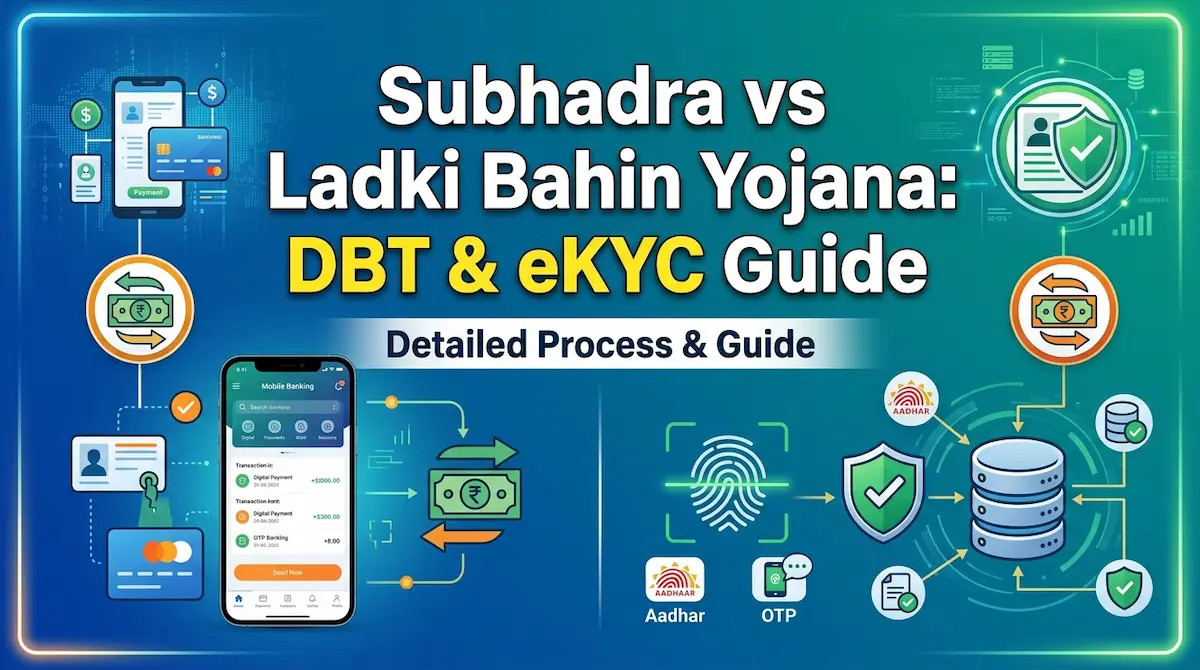
Subhadra vs Ladki Bahin Yojana: DBT & eKYC Guide
Women’s direct benefit transfer schemes have become an important part of state welfare in India. Odisha’s Subhadra Yojana and Maharashtra’s Majhi Ladki Bahin Yojana both support women through cash assistance, but they are not the same scheme. Each has its own state rules, eligibility checks, payment cycle, bank requirements, and verification process.
This comparison explains the main differences in a simple way so applicants can avoid confusion while checking eligibility, DBT payment status, eKYC, and official updates.
What Is Subhadra Yojana?
Subhadra Yojana is a women-focused financial assistance scheme of the Government of Odisha. It is meant for eligible women in Odisha and provides support through Direct Benefit Transfer, commonly called DBT.
Under the scheme structure, eligible beneficiaries receive ₹50,000 over five years. The yearly benefit is ₹10,000, generally paid in two installments of ₹5,000 each. The payment is linked with Aadhaar-enabled and DBT-enabled bank accounts, which helps reduce middlemen and makes fund transfer easier to track.
What Is Majhi Ladki Bahin Yojana?
Majhi Ladki Bahin Yojana is Maharashtra’s monthly financial assistance scheme for eligible women. The scheme is run for women residents of Maharashtra who meet the age, income, bank account, and category conditions notified by the state.
Eligible women receive ₹1,500 per month through DBT. The official scheme information mentions women aged 21 to 65 years, Maharashtra residence, family income limit, and Aadhaar-linked bank account as important conditions.
Subhadra Yojana vs Ladki Bahin Yojana: Main Difference
The biggest difference is the state and payment pattern. Subhadra Yojana applies to Odisha and gives yearly assistance in installments. Ladki Bahin Yojana applies to Maharashtra and gives monthly assistance.
Subhadra Yojana supports eligible women in Odisha, while Maharashtra’s Ladki Bahin scheme has its own rules for eligibility, eKYC, bank account linking, status checks, and monthly DBT payments.
Because both schemes use similar words such as beneficiary list, Aadhaar, DBT, status check, and bank verification, many users mix them together. Applicants should always check the state-specific process before submitting details or trusting any unofficial update.
Eligibility Comparison
Subhadra Yojana Eligibility
Subhadra Yojana is designed for eligible women of Odisha, mainly in the 21 to 60 age group. The scheme uses Aadhaar, bank account verification, and government database checks to confirm eligibility. Applicants usually need to make sure their Aadhaar details, bank account, and DBT status are correct.
Ladki Bahin Yojana Eligibility
For Ladki Bahin Yojana, the applicant should be a woman resident of Maharashtra. The official eligibility details include the 21 to 65 age group, Aadhaar-linked bank account, and family annual income not exceeding ₹2.5 lakh. Married, widowed, divorced, abandoned, destitute women, and one unmarried woman in a family may fall under the listed beneficiary categories if other conditions are met.
DBT Payment and Bank Account Rules
Both schemes depend on bank account accuracy. A small mismatch in name, Aadhaar number, mobile number, or bank linking can delay payment.
For Subhadra Yojana, the benefit is credited to an Aadhaar-enabled and DBT-enabled bank account. For Ladki Bahin Yojana, the monthly ₹1,500 benefit is also sent through DBT, and the bank account should be linked with Aadhaar.
Before checking payment status, beneficiaries should confirm three things: Aadhaar is active, the bank account is not closed or dormant, and DBT mapping is enabled.
eKYC and Status Check
eKYC is used to confirm the identity of the applicant or beneficiary. In welfare schemes, it helps reduce duplicate records, wrong claims, and payment errors.
Subhadra beneficiaries may need to complete eKYC through the state process or assisted service centers where applicable. Ladki Bahin beneficiaries should follow Maharashtra’s official process for Aadhaar verification, login, application status, and payment updates.
Status checking should always be done through official portals or trusted state service points. Users should avoid sharing Aadhaar OTP, bank OTP, or login passwords with unknown agents.
Read also: Subhadra Yojana 5th Installment: August 2026 News
State-Wise Differences at a Glance
| Point | Subhadra Yojana | Ladki Bahin Yojana |
|---|---|---|
| State | Odisha | Maharashtra |
| Main benefit | ₹50,000 over five years | ₹1,500 per month |
| Payment mode | DBT | DBT |
| Bank need | Aadhaar-enabled DBT account | Aadhaar-linked bank account |
| Main users | Eligible Odisha women | Eligible Maharashtra women |
| Status check | Odisha scheme portal/process | Maharashtra scheme portal/process |
Final Advice for Applicants
Do not judge eligibility only from social media posts or forwarded messages. These schemes are updated through government rules, audits, beneficiary verification, and bank-level checks.
If payment is delayed, first check Aadhaar-bank linking, DBT status, eKYC, application status, and eligibility. If everything looks correct, contact the official state helpline, local office, CSC, Mo Seva Kendra, or the relevant women and child development department support channel.
Subhadra and Ladki Bahin are both women welfare schemes, but they belong to different states. The safest step is to follow the correct state portal, keep documents updated, and never share sensitive OTP or banking details with anyone.