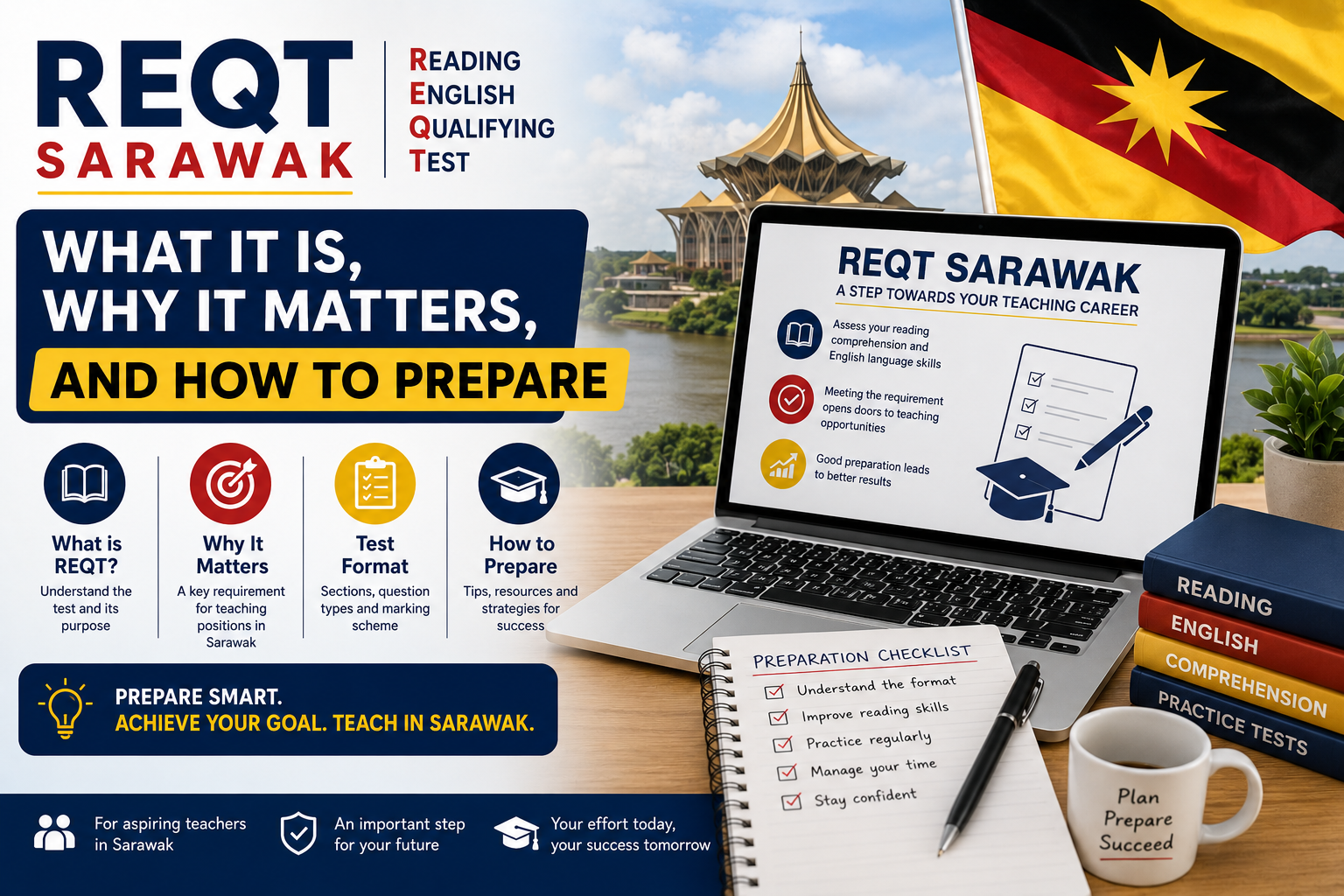
REQT Sarawak: What It Is, Why It Matters, and How to Prepare
If you’re planning to apply for a government position in Sarawak, you have almost certainly come across the term “REQT.” REQT stands for Recruitment Examination and Qualifying Test (also referred to in some official documents as the Online Recruitment Entry Qualification Test), and it is the mandatory screening exam used by the Sarawak State Public Service to filter candidates before they can move on to the interview stage. For candidates looking for structured study guides, mock questions, and a timed practice simulator built specifically around the current exam format, resources such as http://reqt.com.my have become a popular reference point alongside official preparation materials. This article walks through what REQT Sarawak actually tests, how the exam is structured, why so many candidates struggle with it, and how to prepare effectively.
What Is REQT Sarawak?
REQT is an online qualifying test administered as part of the recruitment pipeline for positions within the Sarawak State Civil Service. It is used for a wide range of roles, from administrative officers (Pegawai Tadbir, Gred N9) to assistant administrative officers (Penolong Pegawai Tadbir, Gred N5) and various other public service grades. Candidates who apply through the official Sarawak e-Recruitment portal and meet the basic eligibility criteria for a given post are invited to sit for the Online REQT before their application can proceed further.
The exam functions as an early-stage filter. Because thousands of applicants often compete for a relatively small number of openings, the Sarawak Public Service Commission (Suruhanjaya Perkhidmatan Awam Negeri Sarawak, or SPA) uses REQT to narrow the applicant pool down to those who demonstrate a baseline level of general knowledge, reasoning ability, and cognitive readiness for public service work. Only candidates who pass this stage are typically shortlisted for interviews.
What Does the Exam Cover?
REQT is not a test of specialised technical knowledge. Instead, it is designed to assess how well a candidate can think under time pressure, process information accurately, and apply general reasoning skills. Based on the exam structure described in official quick-guide materials and widely shared by exam-preparation sites, REQT typically covers the following areas:
- Sarawak History and Geography – questions on the state’s colonial history (including the Brooke era), its formation as part of Malaysia in 1963, its administrative divisions, major rivers, national parks, and cultural landmarks.
- General Knowledge – current affairs, the structure of the Sarawak state government and public service, and basic civic knowledge relevant to a public servant.
- Language Proficiency – reading comprehension and basic language skills in both Bahasa Malaysia and English.
- Numerical and Quantitative Reasoning – basic arithmetic, percentages, ratios, and simple word problems, usually to be solved without a calculator.
- Logical Reasoning / IQ-Style Questions – pattern recognition, sequences, and problem-solving questions designed to test analytical thinking rather than memorised facts.
- Psychometric Assessment – a personality and behavioural component that gauges traits such as conscientiousness, integrity, and suitability for public service roles, often presented as “agree/disagree” style statements.
More recent versions of the exam are commonly described as following a “generic section first” format: a large block of numerical, logical, and general-knowledge questions that all candidates face regardless of the post applied for, followed by a functional section tailored to the specific role. Preparation resources increasingly emphasise that this generic section is the real bottleneck for most candidates, since it is often underestimated in favour of studying position-specific material.
Exam Format and Time Pressure
One of the most consistent pieces of feedback from past candidates is that REQT is less about “knowing the answer” and more about managing time. Recent test formats reportedly involve around 90 questions to be completed in roughly 90 minutes — an average of about one minute per question. That sounds manageable on paper, but in practice, a handful of slower calculation-based questions can eat into the time available for the easier ones later in the test, causing otherwise well-prepared candidates to run out of time before completing the paper.
The exam is conducted entirely online through the official Online REQT system, accessed after a candidate has been notified via the Sarawak e-Recruitment portal. Because it is computer-based, candidates also need to account for practical factors: a stable internet connection, a quiet environment free of distractions, and familiarity with navigating an online, timed testing interface — since technical hiccups or unfamiliarity with the platform can cost valuable minutes.
Why So Many Candidates Struggle
Given the scale of competition — often hundreds of thousands of candidates sitting for a limited number of vacancies each recruitment cycle — even small inefficiencies in exam technique can make the difference between passing and failing. A few recurring struggles reported by past candidates and exam-prep resources include:
- Underestimating the generic section. Many candidates focus heavily on job-specific knowledge and neglect the numerical, logical, and general-knowledge sections that actually determine most of the score.
- Studying outdated material. Because the test format has changed over different recruitment cycles, notes and question banks prepared for older versions of REQT may no longer reflect the current structure, length, or difficulty balance.
- Poor time allocation. Spending too long on a handful of tricky calculation or reasoning questions, leaving too little time for the remaining items.
- Lack of familiarity with the online format. Candidates who haven’t practised in a timed, on-screen environment often experience unnecessary stress that affects performance, even when they know the content.
- Overlooking the psychometric component. Some candidates treat the personality-style questions as an afterthought, without realising that consistency and honesty in responses are also being evaluated.
How Candidates Typically Prepare
Because REQT is not tied to a single official syllabus in the way a school examination might be, preparation tends to rely on a mix of official guidance and independently produced study material. Common preparation strategies include:
- Reviewing Sarawak-specific general knowledge, such as state history, geography, festivals, and the structure of state versus federal departments — since these are considered comparatively easy marks for well-prepared candidates.
- Practising numerical reasoning under time pressure, particularly percentages, ratios, and basic arithmetic series, since these tend to be the most time-consuming question types.
- Working through logical reasoning drills to build pattern-recognition speed, since these questions reward quick recognition rather than deep calculation.
- Taking timed mock tests or simulators that mimic the real 90-question, 90-minute format, so that pacing becomes closer to automatic by the time of the actual exam.
- Brushing up on reading comprehension in both Bahasa Malaysia and English, since misreading a question under time pressure is a common cause of avoidable mistakes.
A number of independent websites and study communities have emerged around this need, offering sample questions, structured guides, and simulators built to reflect the newer exam format. Resources like reqt.com.my, for example, describe themselves as private, independently produced reference and preparation platforms — explicitly not affiliated with the Sarawak State Government or the Public Service Commission — offering original practice questions (not leaked exam content), timed simulators for the generic section, and guides comparing the older and newer test formats. Regardless of which resource a candidate uses, it is worth double-checking that the material reflects the current exam format, since candidates who rely on older notes risk practising a structure that no longer matches what they will actually face.
A Note on Official Information
Because REQT is directly tied to public sector recruitment, candidates should always treat the official Sarawak e-Recruitment portal as the primary and authoritative source for exam scheduling, eligibility, and result notifications. Third-party guides and practice platforms can be genuinely useful for building familiarity and speed, but they are supplementary tools rather than official channels. Anyone preparing for REQT should confirm test dates, venue or platform details, and any changes to the exam format directly through official government communications before relying solely on independent study material.
Final Thoughts
REQT Sarawak is best understood not as a knowledge test in the traditional sense, but as a screening tool that measures how efficiently a candidate can think, calculate, and make decisions under pressure. Its heavy reliance on generic reasoning — numerical, logical, and general-knowledge questions — means that broad, consistent practice tends to pay off more than last-minute cramming of job-specific facts. For candidates serious about a career in Sarawak’s public service, treating REQT preparation as a skill to be trained, rather than a syllabus to be memorised, is generally the more effective long-term strategy.